Showing posts with label news. Show all posts

December 18, 2011

I am still in Mumbai: Veena Malik


Mumbai/Islamabad (PTI): Actress Veena Malik today denied reports that she had quietly returned to Pakistan following her nude photo shoot controversy, saying she was resting in a suburban Mumbai hotel to recover from exhaustion.

Against the backdrop of reports that she had mysteriously disappeared, Veena said she had changed her hotel in Mumbai and switched off her mobile phone as she wanted to rest. She told Geo News channel that she had been feeling unwell after working for up to 18 hours a day.

The 33-year-old actress said she was now staying at the Oakwood Hotel in Mumbai, a fact confirmed by the local police. Veena's conversation with Geo News marked her first contact with anyone in two days.

Earlier, speculative media reports on both sides of the border had claimed Malik had crossed over to Pakistan via the Wagah land border. The reports further claimed the actress, wearing a burqa, had crossed the frontier on foot.

But the police confirmed today that the actress is very much in Mumbai. "Veena Malik is in Oakwood hotel. She has registered by her real name Zahida and she has all the papers. She was unwell for a couple of days," Machendra Bodke of Juhu police station told media persons.

Malik went "missing" two days ago after returning from a film shoot in Mumbai. Her manager Pratik Mehta told the media that her cell phone was turned off.

The actress, who has been in and out of India for film and reality shows, was shooting 'Mumbai 125 kilometres' in Goregaon and left the shoot midway, saying she was not well.

However, the police said that there was no missing person's complaint registered in this connection.

Some reports had suggested that Malik had returned to Pakistan to renew her Indian visa but sources close to the actress said her visa was valid till December 24.

The actress' family in Islamabad said it had no information about her whereabouts. Malik was recently criticised by hardliners and extremists in Pakistan for appearing topless on the cover of FHM India magazine with the letters ISI painted on her arm.

She filed a suit against FHM India, claiming damages worth Rs 100 million, while the magazine counter-sued her for Rs 250 million.

After finishing this movie, Veena is also slated to appear on Imagine TV's reality show 'Swayamvar', where she will be searching for her 'Mr Right'.

December 14, 2011

Petrol prices may go up by 65 paise; record fall in rupee makes hike inevitable

New Delhi: Petrol prices may be hiked by Rs 0.65 per litre this week if state-owned oil firms manage to get political approval for the move.

While a fall in the rupee to an all-time low of Rs 53.75 per US dollar has resulted in an increase in the cost of oil imports, international rates of gasoline - against which domestic petrol prices are benchmarked - have also increased, a top source at a state-run oil firm has said.

"The under-recovery on petrol is Rs 0.55-0.56 per litre. After adding local sales tax, the desired increase in Delhi comes to Rs 0.65-0.66 a litre," he said, adding that the oil companies will review prices on Thursday and any change will be effective from December 16.

State-owned oil firms have cut petrol prices on two occasions in the past one month after international oil rates eased.

The companies reduced petrol prices by Rs 2.22 per litre, or 3.2 per cent, from November 16 and followed this with a Rs 0.78 per litre cut from December 1.

The source, however, could not say if oil companies will go ahead with increasing prices on Thursday, in line with the practice of changing rates every fortnight. "The actual loss to us is only 50-55 paise. We can tolerate it for another fortnight if need be," he said.

Public sector oil firms, which revise petrol prices on the 1st and 16th of every month based on the average international rates of the previous fortnight, may informally consult the parent Petroleum Ministry before taking a decision.

Parliament is in session and an increase in petrol prices may lead to protests by Opposition parties.

The price of gasoline has averaged $ 111.11 per barrel in Singapore this month, up from $ 108.25 a barrel in the previous fortnight.

December 13, 2011

Ram Gopal Varma had said he won't make a film on 26/11, but he never said he won't go back on his words (RGV to make the movie)

RGV who had seen the devastation at Taj hotel post 26/11 attack first hand says the idea for the film stuck him only now. Also Riteish Deshmukh won't star in it.

Ram Gopal Varma has finally announced that he will be making a film on the 26/11 terror attacks in Mumbai. The film is tentatively titled '26/11'. Says the maverick filmmaker, "26/11 is a date no Indian will ever forget. The three-day live telecast of the terrorist carnage had people's eyes glued to the television sets across world".

Three years back, RGV's walk through the half-burnt Taj hotel accompanied by the then chief minister Vilasrao Deshmukh and his actor son Riteish Deshmukh had led to speculations that he might be going to make a film on the attacks then. But Varma had denied he was invited by Deshmukh and his son to visit Taj so that he could see the devastation first hand and portray it realistically in a movie.

"I only got the idea now. I have enough knowledge and understanding of the events now. Also, at that point the allegations were about Riteish being a part of this project, which he is not," says Varma.
Ram Gopal Varma with Vilasrao Deshmukh and his son Riteish Deskhmukh
He adds, "Everyone more or less has seen or heard of what happened during that time. But my attempt now would be not only to capture the physical aspect but also behind the scenes aspects of what exactly happened from the time Kasab and rest of the team landed on Amar Singh Solanki's trawler in the high seas, till Kasab's heroic capture by the late Tukaram Ombale at Girgaum Chowpatty. This will be inter-cut with what the various gallant police officers did in their attempt to get the situation under control."

Varma is being assisted by Rommel Rodrigues, author of 'Kasab the face of 26/11', who has an extensive and encyclopedic knowledge of the event but the film will not be based on the book. The film would be made for both national and international audiences. It will have completely new cast to create a heightened sense of reality.

"After my tryst with so called the underworld films, I would consider this film as a greatest challenge of my career", concludes Ramu.

December 10, 2011

Woman sales manager who endured porn in the office and new recruits chosen by their bra size wins £26,000 compensation


London: A sales manager bullied by sexist colleagues who rated potential female recruits by their bra size has won £26,000 compensation after being forced to quit.

Angelina Ashby, 41, described her office as a boys’ club where women were deemed as ‘being over-emotional and sensitive’.

She said that among the worst offenders was sales manager Peter Smith, who is a married father of three.

He chased a woman around the office and spanked her on his knee while encouraging others to grab his private parts, an employment tribunal was told.

He also viewed blow-up dolls and sex toys on the internet at work, said Miss Ashby.

Despite complaining to bosses, nothing was done to stamp out the culture of sexism at the marine supplies company, Cathelco.

Other incidents included male staff drawing insulting cartoons about Miss Ashby’s weight and calling her ‘fat face’ in an email, the tribunal heard.

Miss Ashby was nicknamed ‘Angel’ by her tormentors. On one occasion, she said she leant over Mr Smith’s desk to collect teacups and sales executive Laurie Wilson said: ‘Never mind, Pete. You have Angel’s **** in your face.’

Miss Ashby won her claim for sex discrimination and constructive dismissal at the tribunal in Sheffield. Judge Robert Little said there was an ‘underlying laddish culture’ at the company.

Miss Ashby, a single mother, started work for the firm in June 2003 and later became a sales project manager on a Ministry of Defence aircraft carrier contract.

She said she was ostracised and her treatment by Mr Smith and other male colleagues drove her to take anti-depressants.

They were regularly heard talking about her in derogatory terms and she believed the jibes were intended to belittle her.

When she finally submitted a grievance, managing director Justin Salisbury told her she had a personality which ‘p***es’ people off’ and ‘in 20 years of business, Cathelco had only ever had a problem with women’.

Miss Ashby, who earned £13,500  a year, said at a later meeting that Mr Salisbury told her ‘they had been very understanding’ towards her.

She resigned in October 2008. She told the tribunal that women had to ‘clearly work twice as hard as male staff to gain career or monetary progression’.

Former employee Alina Taylor, 37, said bosses would openly talk about prospective female recruits and said ‘pretty girls always get jobs at Cathelco’.

She added that two of the men ‘would often talk about the  girl’s bra size as being criteria for employment’.

Cathelco, based in Chesterfield, denied all the allegations, claiming Miss Ashby was ‘unmanageable’ and ‘not a team player’.

The tribunal heard she got a job as a hospital administrator but was dismissed last July because of time she took off with anxiety and depression.

She told the tribunal: ‘I firmly believe the depression was attributable to the treatment I suffered at Cathelco.’

Miss Ashby twice broke down in tears as she told how the bullying had affected her health, her son’s behaviour and caused her loss of self-esteem.

‘I have been reduced to someone who is completely lacking in self-confidence and is depressed and no longer the vibrant person I was,’ she added. Her retired father, Marwan, 69, who is paying her £43,000 legal bill, told the tribunal that the company had ‘destroyed her’.

‘My daughter used to be an assertive, confident woman,’ he said.

Miss Ashby was awarded £26,061, made up of £15,000 for injury to feelings and £9,158 for loss of earnings, as well as compensation for loss of statutory rights.

Afterwards, Miss Ashby said: ‘I’m pleased it’s all over. It was not about the money it is about justice. My father is footing my legal bill so he is still going to be out of pocket.

‘I’m hoping to rebuild my life and get back into customer services.’

Source: Daily Mail

India is independent? My foot! UPA govt has kept the country in chains, says Anna Hazare

Anna Hazare has decided to take on the central government once again. Ahead of his day-long fast for a strong Lokpal Bill, Hazare on Saturday launched a scathing attack on the government, charging that it was "intoxicated" by power and said the "second fight for independence" has started which will go on till corruption is eradicated.

Before leaving for Delhi where he will hold the fast, Hazare said, "So many martyrs lost their lives for our independence but even today we cannot experience independence. Who got independent. What independence? Corruption, loot is still here. Only 'goras' left and 'kalas' came in, that is the only difference."

"So the second fight for independence has started, it is a long fight, till corruption gets eradicated, it will go on. Many people will have to got to jail again, be lathicharged, some will have to sacrifice, that time is here now. Till we sacrifice, we won't get the right independence," Hazare told reporters here.

Keenly observed by government and people, the activist will sit at Jantar Mantar, the protest hotspot in the national capital, the whole day along with his supporters demanding a strong anti-corruption law.

Hitting out at the government, Hazare said, "This government is intoxicated by power and money. It cannot see anything else. They have forgotten the sacrifices by the likes of Bhagat Singh, Sukhdev and Rajguru. Like a drunk man becomes unconscious, similarly the government is unconscious.

"It is our job to get them into their senses. This in only a day-long agitation, after December 27, it will be a long agitation. Today that you all are here, I am energised," he said.

This will be Hazare's second protest at Jantar Mantar on the issue, the first being the hugely successful five-day fast from April five which forced the government to set up a joint committee of government and activists to draft Lokpal Bill.

Team Anna and police expect a large turn out at the venue and adequate police personnel are being deployed at the spot.

Dominique Strauss-Kahn liked rough sex, says hooker who slept with him

PARIS: Disgraced former International Monetary fund ( IMF) chief Dominique Strauss-Kahn was 'treated like the Messiah' when he arrived at orgies, a prostitute who took part in his group sex sessions has disclosed.

Belgian hooker Jade revealed how she had sex with Strauss-Kahn on the night before he was arrested for trying to rape a New York hotel chambermaid on May 14, The Daily Mail reports.

Jade praised the shamed 62-year-old French politician for his 'courtesy and respect' during the sleazy swingers' parties during an interview with a French newspaper Nord-Eclair.

"I must say, I found DSK to be very pleasant and overly polite. Each encounter with him was mutually respectful. I have always ensured I am seen as a woman and not an object. When people respect each other, nothing bad happens," she said.

She also spoke of the atmosphere at one orgy that was 'packed with well-known people' at Paris's four-star Murano Hotel, as they waited for Strauss-Kahn to arrive.

"Everyone was saying, 'He's on his way'. I asked who they meant, as I had not heard of him at the time. They all seemed to be waiting for Dominique like the arrival of the Messiah," the paper quoted Jade, as saying.

"When he turned up, everyone was as usual very admiring of him. He always had a certain charisma about him, an aura. Although at that session I had very little contact with him," she added.

According to the paper, another prostitute named Florence said she took part in 11 orgies over six years with Strauss-Kahn.

"At these evenings, DSK had sex with every girl in the room. I'm not saying he raped me, but I got the feeling that he liked rough sex," she added.

December 8, 2011

Gone are the days when India used to be sweetheart of MNCs: Microsoft

Global software major Microsoft today said that for MNCs, India is no longer a preferred destination.

"It doesn’t make sense any more. For MNCs India is no longer a preferred destination. We have lots of issues concerning our operation here," Microsoft India chairman Bhaskar Pramanik said when asked if the company is considering any R&D centre for West Bengal as it seeks to work closely with the state government.

He was speaking to reporters on the sidelines of Infocom 2011 conference organised by Businessworld.

Pramanik later clarified that he was speaking about technology and IT companies.

"I think a lot of that need to be resolved. We have to be cautious about any new investment in the state," he said.

Asked what the issues were, he declined to list the challenges or issues the technology MNCs were facing.

"I think you had better talk to Nasscom. It is the voice of the industry," he said.

Nasscom regional (east) head Suparno Moitra declined to comment.

Asked to throw more light on 'preferred destination', Pramanik said, "I think we look at everywhere in the world. I think choices are many," he said.

Meanwhile, reacting to the Centre's decision to suspend FDI in multi-brand retail till a consensus is evolved, Pramanik said he felt disappointed with the government’s decision.

"FDI in all form is good - be it in retail or aviation," he said.

"We have a strong corporate sector, central and state governments. Checks and controls could be put in place to ensure net gain for the country in terms of employment, growth and earning rather than being negative," he said.

Social media censor row: Uncle Sam hints that India should ignore ministers like Sibal


Asserting that freedom of expression applies equally to the Internet as it does in the real world, the United States has said that it is in talks with Indian government over the regulatory mechanism on Internet.

"We believe that freedom of expression applies equally to the Internet as it does in the real world," the State Department spokesman, Mark Toner, told reporters at his daily news briefing when asked about the efforts of the Indian Government to regulate/monitor content postings on the Internet and social network sites like Facebook.

However, the State Department spokesperson clarified twice that its position on internet freedom is not necessarily India specific, but in general globally.

"We are concerned about any effort to curtail freedom of expression on the Internet," he noted.

Indian Telecom Minister Kapil Sibal yesterday said that the government has asked companies including Google and Facebook Inc to block offensive material, especially content that could hurt religious sentiments of some Indians.

With India, Toner acknowledged that this is indeed one of the topics of discussion with the Indian Government and is part of the strategic dialogue.

"In terms of India we do have a working group on information and communication technology between the US and India, and it's part of our overall strategic dialogue.

"Of course, we within that working group do talk about issues on information technology, discuss approaches our governments can take to create investment, for example, on regulatory environments that maximise the development of these sectors," Toner said in response to a question.

The State Department said America's position is very clear and the Secretary of State, Hillary Clinton, is scheduled to deliver a major speech on internet freedom in The Hague today.

He did not give an insight in to the much anticipated speech, but the recent developments in India and South Korea in this regard is most likely to figure.

"Our position's clear. Secretary Clinton's called on the global community to protect freedoms of expression,association and assembly in the online world as we do in the regular world. We uphold those beliefs. I don't want to get out too far in front.

"She's actually going to be talking about freedom of expression, internet freedom, in the address in The Hague, so I don't want to pre-empt that speech," Toner said.

December 5, 2011

Opposition gang-rapes idea of FDI in retail, helpless govt dumps comatose plan into ICU

Opposition parties on Monday stuck to their guns on a complete roll-back of the foreign direct investment (FDI) in retail, forcing the government to call an all-party meeting, likely Wednesday, as the reform measure was put on hold pending a political consensus. Finance minister Pranab Mukherjee spoke with Bharatiya Janata Party's (BJP) LK Advani and Sushma Swaraj and Left leader Sitaram Yechury to convey the government's decision to put the major reform policy in abeyance.

However, the reaching out failed to cut any ice with the opposition leaders, who asked the government to hold an all-party meeting and clear its stand to end the parliament logjam.

Nearly half of the winter session has been lost due to protests and slogan shouting by opposition members over various issues, including against the FDI in retail.

Giving in to the demand, the government has decided to call the meeting on Wednesday, according to sources.

Parliamentary Affairs Minister Pawan Kumar Bansal did not confirm the date but said the meeting would be held "soon".

The decision to call an all-party meeting comes after Mukherjee, according to sources, was told by opposition leaders that they want a complete rollback of the policy and not just its suspension.

The sources said the key Congress troubleshooter assured them the government would consult opposition parties and also various stakeholders before taking a final decision on allowing the FDI in Indian retail market.

He also requested them to let parliament run because some of the crucial legislations, including the anti-graft Lokpal bill, were to be passed in the session that ends Dec 22.

Sushma Swaraj confirmed she spoke to Mukherjee. "He called me. I told him either roll back the FDI decision or have a debate under an adjournment motion," she told reporters in Indore.

Yechury also confirmed he talked with Mukherjee.

"He (Mukherjee) said they want the parliament to continue and I replied that we always wanted parliament to continue," Yechury said.

At the heart of the controversy is a Nov 25 cabinet decision to allow 51 percent foreign ownership of multi-brand retail stores and 100 percent in single brand outlets.

The opposition and key Congress allies, the DMK and the Trinamool Congress, say the decision would hurt millions of farmers and small traders of India by allowing international super-chains like Wal-Mart and Tesco to set up their shops in the country.

Giving in to the opposition, the government Saturday informed Trinamool chief Mamata Banerjee, the West Bengal chief minister and a bitter critic of the policy, that it would put the decision on hold, pending consensus.

The surrender by the government is being seen as a set-back to Manmohan Singh's first major reform decision since he regained power in 2009.

But Law Minister Salman Khurshid dismissed the notion that it was a set-back to the government.

"Not at all," Khurshid said, adding "not everything you want to do gets done in the time frame you want it".

Congress spokesperson Renuka Chowdhary told reporters that the party was "open minded" over the issue and any formal announcement regarding it would be made in parliament.

She accused the BJP of having "double standards" over the FDI in retail, referring to the opposition party's 2004 election manifesto in which it had promised to get foreign equity to boost Indian retailing.

Parliament will resume on Wednesday after an extended weekend of four days.

Hindustan Times

December 4, 2011

I do not like girls who openly talk about condoms and sex, Dev Anand said once

Gaurav Malani

It was exactly in this week last year that I met Dev saab in his Khar office with some of my office colleagues. And it just seems yesterday. It was more of a casual conversation with him rather than a formal interview on any of the two of his upcoming films. So we never bothered to take down notes or record it for official purpose. But such was his impact that his words still linger fresh in my mind.

Two of his films were scheduled for release back to back, one being the coloured version of his 1962 classic, Hum Dono, and other his latest directorial venture, Chargesheet.

"People would get to see the young Dev Anand and the present Dev Anand in quick succession", said the elated actor. In the 88th year of his life, the actor still showed no signs of ageing as far as his cinematic ambitions were concerned. Post Chargesheet, he wished to come up with a sequel to another of his superhit films, Hare Raama Hare Krishna. While he was upbeat about the idea of renovating classics and taking the legacy of his films forward, Dev Anand was strictly against remakes. "Why would you want to meddle with the classics?" This was also the time when Dev Anand had been strongly opposing the remix version of the song, Dum Maaro Dum, which was being used as an item song in Rohan Sippy's film.

Dev Anand also kept himself updated with the changing times and technological advancement. He was completely amazed by the power of internet and was perhaps the only actor of his era to have an active Twitter account. Naturally then he was a very open-minded person and not stuck with the conservativeness of his times. "Ask me anything and everything that you want", said the senior actor putting our apprehensions to rest. He didn't take offence to any question and never ever showed any high-handedness in answering any of them.

Could he fall in love even today asked a colleague and he candidly replied, "Why not? You cannot stop yourself from falling in love. But I am a responsible man. I have a wife and son. So I know where to draw my lines". Ask him what did he think of the woman of today and he said, "They are beautiful. Par hamare zamane mein nazakat hua karti thi. The girls had a natural charm. Today it's more artificial. I don't like girls who openly talk about condoms and sex".

Like Hum Dono, Dev Anand wanted to bring back many of his black and white classics in the coloured format so that the present generation could enjoy it. Reviving memories of his times he says, "If I wanted, I could have ruled half of Bombay". And such was his stardom that one doesn't overlook his statement as a mere exaggeration. Dev Anand enjoyed immense popularity throughout his lifetime and wasn't a faded star even in his last days.

Dev saab was getting his Juhu residence refurbished at that time and assured us that the next time we meet it would be at his newly-done pad. Unfortunately that will never happen now. We will miss you for ever after Dev Anand. They don't call you evergreen for no reason!

Source: The Times of India

December 2, 2011

FDI in retail row: I won't shake my hips with you, but I won't kick your butt either, Mamata Banerjee tells Manmohan Singh

DANKUNI (WEST BENGAL): Remaining firm in her party's opposition to the UPA government's decision on FDI in retail, Trinamool Congress chief Mamata Banerjee has told Prime Minister Manmohan Singh that her party is not in favour of the government being toppled.

"I have had a discussion with the Prime Minister on FDI in retail. I told him that we don't want the government to be toppled on this issue. This is a very sensitive issue. But at the same time, it is not possible for us to support FDI entry into retail. I am sorry," the Trinamool Congress chief told reporters after an administrative meeting here in Hooghly district.

"Since you are requesting me, we can discuss this in the party. But our party's stand is clear," she said.

Urging the Prime Minister to reconsider and withdraw the Centre's decision, she said, "If necessary, the government should talk to all UPA partners and seek suggestions and ensure that the move is withdrawn."

"The Prime Minister requested me to reconsider my party's stand (on the issue). I requested him if the Centre could reconsider the decision. We have a definite stand on this issue. Our party's stand on this is declared in our manifesto," she said.

PM speaks to Mamata on FDI 

Earlier, Prime Minister Manmohan Singh on Friday reached out to Mamata Banerjee, the leader of key UPA constituent Trinamool Congress which is opposing the Centre's decision to allow FDI in retail.

Singh spoke to Banerjee, PMO sources said about the phone call made with an apparent aim of enlisting her party's support while citing the benefits the Centre's decision would accrue.

Trinamool Congress has been vociferously opposing the decision to allow 51 per cent foreign direct investment in multi-brand retail and 100 per cent FDI in single brand retail.

The Prime Minister on Thursday convened a meeting with leaders of Trinamool along with DMK, which is also opposed to the decision, but they remained unconvinced.

Singh gave no assurance on accepting the demand for rollback of the decision.

Trinamool Congress leader Sudip Bandopadyay, who represented his party at the meeting, later said the allies appealed to the Prime Minister to accept their request for rollback of the FDI decision.

"Sometimes allies may extend suggestions to bigger parties. It is not a Congress government. It is a combined government of ally parties," he had said.

Rejecting intense demands, the Prime Minister on Tuesday justified the decision on FDI as a well considered move aimed at creating jobs, improving remuneration of farmers and enabling import of technology besides benefiting consumers.

December 1, 2011

In world's biggest democracy, MPs don't like to work. They take the country's pants off, lean back and just enjoy the tamasha


India's parliament has always been a boisterous and chaotic place that, like the country itself, still somehow worked: these days, it's not even muddling through.

Proceedings have been abruptly called off every day so far since the 21-day winter session of the bicameral parliament opened last week because of the din raised by legislators bawling at each other across the floor of the house.

Open debate is treasured in the world's largest democracy. However, patience with members of parliament who head off for the day after a few minutes of bellowing is wearing thin. One TV news network asked watchers this week to answer if there should be a new rule for legislators: "No work - no pay".
An estimated Rs 2,600,000 crore or $50,000 in running expenses and MPs' daily allowances is wasted for every hour of parliamentary time lost. But the biggest cost is caused by the legislature's failure to introduce, debate and pass bills crucial to the functioning of the state and its economy.

Data compiled by PRS Legislative Research, an independent organisation that tracks the functioning of parliament, shows that the government of Prime Minister Manmohan Singh had planned to pass 200 bills over the seven sessions since it was re-elected in 2009, but managed just 57.

Disruptions meant an average of 35% of sitting time was lost in the Lok Sabha over those sessions, and 17% of the bills passed there were done so after less than five minutes of debate.

"The purpose of parliamentary democracy is to provide a forum for reasoned deliberation," the Times of India fumed in an editorial. "By wrecking this very platform, MPs can neither resolve contentious issues nor do their jobs as lawmakers."

Policy paralysis

Amid the logjam, lawmakers found time on Wednesday to call for their status to be upgraded on a list of India's VIPs. A committee submitted a report that called for MPs to have flashing lights put on their cars that would allow them to speed through the country's clogged streets, local media reported.

Another recommendation was to teach civil servants to be more courteous to politicians, after "recurrent instances" of protocol violations, the Press Trust of India reported. The committee expressed its "displeasure" at lawmakers' ranking, which was "much below their status", the news agency said.

The latest stalemate in parliament has come over Singh's decision to push through cabinet a new regulation that allows foreign supermarket chains to enter the country's long-protected retail sector, with opposition lawmakers haranguing the government side from the moment proceedings get underway.

Hobbled by a string of corruption scandals, the government has dithered on reform in its second term, and Singh has lost much of his credibility as the reformer who turned India around from near-bankruptcy 20 years ago to an economic wonder.

The appearance of parliamentary dysfunction only adds to a sense of policy paralysis that puts investors off India at a time of slowing growth.

C.V. Madhukar, director of PRS Legislative Research, argues that the parliamentary rules of engagement need an overhaul. He suggests that India could take a leaf out of the rule book of its former colonial ruler, Britain, where the opposition is allotted 20 days per year when it can set the agenda.

"It's not like that in India," he said. "When the opposition wants to raise something the government has to agree."

Source: Business Standard

FDI in retail: You think it's for farmers? Stupid! Get real, it's all about realty


By R Jagannathan

The god-awful political scrap we are witnessing over allowing foreign direct investment (FDI) in retail is, of course, a load of bull.

Barring perhaps the Left (who are congenitally opposed to all ‘neo-liberal’ policies) and the BJP (which was originally a party of petty traders and kirana merchants before it came to power in Delhi in 1998), nobody is actually opposed to FDI in retail.

In fact, politicians as a class are all for it (of which, more later). This is why the Manmohan Singh government, which has been petrified about implementing any kind of reform, actually went ahead with the announcement and is still sticking to its guns on the issue.

There are four reasons why allowing FDI in retail makes huge political sense to the Congress-led UPA.

First, there is the nothing to lose argument. The fact is the economy is in a mess, and prices are not going to stabilise easily in the foreseeable future. No matter what the government does in the short term, prices will rise as all energy prices are currently understated (coal, power, oil, etc). These will have to be raised sooner or later – giving inflation another push.

Food prices will not fall because of the expensive Food Security Bill that the UPA is about to unwrap. The rupee has been weak, and tumbling, as foreigners are reluctant to bring in capital when they need more of it back home (in Europe, US and elsewhere). A weak rupee means more imported inflation. Pranab Mukherjee’s budget arithmetic has been shot to pieces and the fiscal deficit is soaring – which puts further demand pressure on prices.

So the prime political calculation behind allowing FDI in retain is that things will anyway get worse – so why shy away from unpopular decisions now? Who knows, it might even do some good over two years – and bring in dividends by 2014.

Second, more importantly, politicians smell money in retail FDI. This is because retail is primarily about real estate. The real estate market is currently in a mess as the affordability factor has disappeared. Realty sales everywhere – especially commercial realty — are crashing, even if prices aren’t. Most listed realty companies are heavily into debt, and they need more equity to reduce debt.

But here’s why politicians are keen on FDI. Most of them hold their ill-gotten wealth in real estate. With elections approaching — UP, Gujarat, many more states in 2013 and the grand finale in 2014 — politicians need a lift in land values to encash their wealth and pay for re-election. This is the prime reason why every landed politician secretly wants FDI in retail – only the Wal-Marts can help raise unaffordable realty prices even more. Real estate analysts like Liases Foras are, in fact, predicting a fall in prices, and this is something politicians cannot afford.

An aside: the real reason why the Telangana issue is not going to be solved soon is that many Andhra politicians hold benami land in Hyderabad – which will have to go to Telangana once the new state is formed. If Telangana happens too quickly, they cannot encash their Hyderabad land – or may even suffer a loss. The delay in announcing statehood — prematurely announced by P Chidambaram on 9 December last year, and retracted two weeks later when Andhra politicians went ballistic – is primarily to force Telangana politicians to protect Andhra politicians’ landed wealth, or at least give them enough time to sell out before the state is divided.

Third, it’s about the farmer and the middle class – the rural and urban vote. The key benefit from creating a strong organised retail sector is that it will cut out the middleman and give farmers higher prices and the urban consumer cheaper products. The problem for the UPA is that the government runs an inefficient food security and public distribution system, which is not only busting the budget through higher and higher subsidies, but also raising food prices overall. The UPA is hoping that FDI in retail will make this chain efficient – at the cost of the BJP-loving kirana shopowners – and take some of the procurement load off the public sector.

That, of course, remains to be the seen, but the objective is clear: if FDI delivers, it would be easier to dismantle the public distribution system in urban India and focus the subsidy system largely on the rural poor.

The BJP’s schizophrenic attitude to FDI in retail comes from the fact that it wants its kirana constituency and the middle class urban voter. Not an easy act to follow.

The fourth point is that our kirana guys are not exactly babes in the wood. Even with the rise of organised Indian retail chains – the Big Bazaars and Reliance Freshes of the world – they have held their own. But they will have some big guns rooting for them as well: consumer goods manufacturers like Hindustan Unilever and Procter and Gamble.

Reason: when the Wal-Marts, Carrefours, Metros and Tescos come, the Unilevers and P&Gs will get squeezed for margins due to the former’s big buying clout. The latter also introduce private labels and shop brands, which commoditises their own premium brands. This is why the Unilevers and P&Gs have a vested interest in backing the kirana shops over big retail – in order to retain bargaining power.

So, it’s not as if the big whales of retailing will overawe and overwhelm the little fish of the kirana world.

For the Congress, FDI in retail is ultimately win-win. It should be able to ride out the current political storm if it makes soft noises and sticks to its basic decision to open up the sector.

First Post

Naysayers, get your facts right: FDI has already benefited India

 
By Anil Dharker

Try and think of this imaginary scenario. It’s 1991, a Congress coalition government rules in Delhi. Our economic situation is terrible — so bad that the government  has had to secretly pledge its gold to keep the country’s head above water. There’s only one solution: to get out of this hopeless morass and to stop India from becoming a basket-case, Manmohan Singh and his Finance Minister Pranab Mukherjee jettison the socialist economic model, so far sacrosanct, and announce a liberalised economy.

But there’s a problem. The BJP-led Opposition does what it does best: it opposes the move, notwithstanding the fact that it wanted to liberalise the economy when it ruled the country. Parliament is brought to a standstill. Slogans are shouted. The Opposition stages walkouts. The house gets adjourned every day. Finally, Singh and Mukherjee bow to the inevitable, and abandon the idea of liberalising India’s economy.

Far-fetched? Not really. Look at what is happening in Delhi now. FDI in retail is an old idea which – like economic liberalisation – has been debated and discussed threadbare for years. The NDA government wanted it in 2003; in fact, Murasoli Maran, the then commerce minister, had recommended 100 percent FDI in retail! Maran, as we know, is part of the DMK, and DMK as we know is now opposing even the 51 percent FDI proposal.

This is not the first time, nor will it be the last, that politicians and political parties do a flip-flop. But if we put aside for a moment the shameful scenes in Parliament and look at issues calmly, this is what we see:

• FDI in retail will benefit consumers

• It will benefit producers, i.e. farmers, who will then sell directly to the retailer through a contract agreement, thus cutting out the middle-man.

Does anyone —  BJP, DMK, Marxists and the others — dispute this? They don’t. They are concerned about the ‘harm’ the new retail policy will do to the kirana shop owner. If you look at the overall picture, there are far more consumers and producers than shop owners, so the opposition is protecting the interests of a minority while ignoring the vital interests of the majority!

This is particularly astonishing coming from Marxists and the Trinamool Congress who espouse the cause of farmers.

As it is, I am not even sure that the kirana shop owner will be hit as badly as people imagine. Take any large city: the kind of space that will be needed by a Wal-Mart is not easily available, so these retail giants will only go to certain areas where they can find real estate.

Kirana shops are really convenience stores where people from the immediate neighbourhood go. Will that change? Will people trek long distances to a Wal-Mart to save money? The only people who will do this are shoppers with cars who might do their month’s shopping as they do now at Big Bazaar and similar outlets.

Question: Have the Big Bazaars killed kirana shops? Answer: No. Are political parties then opposed to Wal-Mart & Co only because they are foreign companies?

I remember – and I am sure you do too – the furore that accompanied the entry of Coca Cola, Pepsi, KFC, McDonald and similar Big Bad Foreigners. So what happened? They are now as Indian in India as any local company. They hire Indian managers and labour, source from Indian producers, use Indian distributors, etc. They have benefited the Indian economy in very many ways…

I wish our frothing politicians would just check this out for themselves. Where do McDonald’s get their patties from? Their potatoes? Their chickens? Where does Pepsi get the raw material for all the snack foods they make? From the US? From Europe? They don’t for the obvious reason that they aren’t crazy.

The crazies are in Parliament. They have done their best to ruin the country, and will continue to ruin it as much as they can if we let them.

Source: First Post

November 30, 2011

FIR against actor Salman Khan for assaulting anti-corruption activist in UP


KANPUR: The police have registered a named FIR against Bollywood actor Salman Khan, his bodyguard Shera and five others at the Kakadeo police station for allegedly assaulting anti-corruption activist Omendra Bharat, an ex-IIT-ian and chief general secretary of Jan Rajya Party, here on August 24.

The anti-corruption supporters had gathered around Salman's vehicle to offer him Gandhi topi and request him to join their agitation when they were allegedly beaten up by Salman's personal security staff.

The agitated activists of Jan Rajya Party later lodged a complaint with the Kakadeo police seeking action against Salman and his bodyguards but no FIR was lodged. "A case was lodged against Salman and his bodyguard Shera besides five others," investigating officer Anup Yadav told TOI.

Times of India

'Sexually perverted beast' attacks girl with meat chopper, gets life term

NEW DELHI: A trial court has sentenced a Blueline bus driver to life imprisonment for brutally assaulting a girl with a meat chopper after she refused to marry him.

Calling him a "psychopath and sexually perverted beast", additional session's judge, Rakesh Tiwari, held Mahman Singh guilty for abducting the victim, Monica, and then attacking her with a meat chopper after she refused to marry him. After inflicting more than 80 injuries on Monica's body, Singh set the room (in which he had kept her) on fire.

"From the ghastly acts of violence which he has committed with the victim, (it's clear) the convict is a sadist of third degree, a psychopath and sexually perverted beast and can go to any extent with this state of affairs of his mind to do any wrong either to himself or to the members of the society," the court said.

The court convicted Singh after taking note of Monica's deposition that he would write letters to her even from jail and terrorized her during his trial. "The convict did not stop here as he has no remorse or repentance and even after committing the crime, he continued to write letters from judicial custody in jail to the house of the victim so as to create a terror in the victim's mind," it said.

Monica, a Kashmiri migrant who worked as a computer operator at Karol Bagh, used to travel from her residence in Hari Nagar to the workplace in a Blueline bus that was driven by Singh, the prosecution said. As Singh would constantly stare at her, Monica grew suspicious of his intentions and stopped travelling in his bus. According to the prosecution, on January 20, 2007, Monica went to a neighbourhood market in Hari Nagar where Singh accosted her and forced her to accompany him to an unknown place near Uttam Nagar. Singh asked Monica if she would marry him but she rejected his proposal. Singh could not handle the rejection and attacked Monica with a meat chopper and then set her room on fire. Some people reported about the fire and Monica was rescued by the police.

The ASJ noted that Monica had received 80 stitches on her body, arm head, face

her left thumb had been chopped off, she had undergone multiple surgeries and her speech was also lost for over three years. Monica also suffered from depression and started shivering at the sight of a meat chopper in the court.

The court denied Singh's plea for leniency, in which he had said that he was married and has a nine-month-old baby. "Admittedly the convict was driving a bus, a public utility service, and by showing any leniency to him, a wrong message will go into society that any girl or female can use the public utility services only if they are ready for their sexual exploitation by the persons who are concerned with providing the said public utility service," the court said.

Anna Hazare loses head, starts talking nonsense on FDI in retail sector


RALEGAN SIDDHI: Opposing FDI in the retail sector, activist Anna Hazare on Wednesday said the move would lead to enslavement of the countrymen and will not benefit the farmers as claimed by the government.

"If people are saying it (FDI) should not happen, why are you insisting? The British came to India to trade and for 150 years, ruled us, enslaved us. Do you want to have a repeat?" he told a press conference here on Wednesday evening.

"They (the foreign investors) will spoil the water and the environment. The government should consider this," he said.

On the claim that farmers will be benefited by FDI in retail, Hazare said, "If it were so, in the 65 years after independence, farmers would not have committed suicides."

He said he favoured unanimity among political parties on the issue. "All parties should rise above narrow considerations. There should be no inter-party differences," he said.

Amitabh first met Rajiv Gandhi when he was 4 years old

Author and journalist Rasheed Kidwai has chronicled the recent history of the Congress in 24 Akbar Road. Here is an excerpt on the highs and lows between the Bachchans and Gandhis

The Bofors scandal took a heavy toll on Rajiv in more than one way. He lost his friendship with his childhood friend, Amitabh Bachchan.

The Gandhis and the Bachchans have never spoken about the actual reason why their friendship soured, but common acquaintances blame it on personality clashes, ego tussles and one-upmanship amid failures and tragedies.

The 'split' has been painful for both sides. For Sonia, it is the loss of the first friend she made in India. Amit, as she affectionately addressed him, was the one who received her off the aeroplane at Palam Airport on the chilly winter morning of 13 January 1968.

Her civil marriage to Rajiv Gandhi took place forty-three days later on 25 February. During this period, Sonia stayed at Amitabh's house with his mother, Teji Bachchan and father, Dr Harivansh Rai Bachchan.

Family friend Mohammad Yunus and Indira Gandhi's confidant, T.N. Kaul, had zeroed in on the Bachchans after Indira said she was not keen on Sonia staying in a hotel or at her residence before the marriage. At that time, Amitabh was yet to become a superstar and Rajiv was a carefree soul.

Along with Ajitabh 'Bunty' Bachchan and Sanjay Gandhi, Rajiv and Sonia were frequently spotted on the India Gate lawns, eating ice cream. Rajiv Gandhi had an old Lambretta scooter, which often had ignition problems. Invariably, either Sanjay or Amitabh had the 'honour' of pushing it for a few metres till it started.

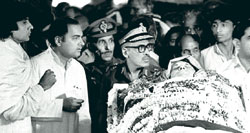
The families were so close that when Rahul and Priyanka grew up, they addressed Amitabh as 'mamun', which is Avadhi for maternal uncle. When Rajiv was assassinated at Sriperumbudur, Amitabh was in London and Rahul in Boston.

They landed in Delhi together from London. Amitabh then took charge of the funeral arrangements with Priyanka, while Rahul stayed at home, trying to console Sonia and accepting condolences.

In several interviews, (Mishra, Sumant, Main Amitabh Bol Raha Hoon: In Candid Conversation, Egmont, Mumbai, 2003) Amitabh has fondly recalled that his first meeting with Rajiv was when he was four years old and Rajiv, two: 'There was this fancy dress party on Bank Road (the Bachchans' residence in Allahabad).

Rajiv Gandhi was two years old and had been dressed up as a freedom fighter. Ma says he messed up his pants. We were all such tiny kids then, absorbed in our little games, that it didn't seem such a big deal that Pandit Nehru's grandson was in our midst.

'He often visited me on the sets, like the time I was shooting for Ganga Ki Saugandh in Jaipur. He was extremely unobtrusive and would wait patiently till I completed my shots. His nature was such that he would never misuse his name or family connections.

On the contrary, more often than not, he would not disclose his surname, fearing the distance it would create between him and the common man,' remembered Amitabh.

He said, 'The last time I met him before leaving for London was in Delhi on 8 May 1991. On the 20th, which was a Monday, the hearing of the Bofors case against a Swedish newspaper began in London.

On the 21st, the judge summarized the case and, on the following Wednesday, the verdict was to be announced. At five o'clock UK time, we returned home after lunch. That's when we received the news of the horrific incident...

'My first reaction was of complete disbelief. The fact that something like this could actually happen was unthinkable. As humans, we find ourselves hoping that we will never be victims of such unspeakable tragedies... I was shocked for quite a while and remained numb and speechless. I am afraid I cannot describe it in words.'

Asked if he considered joining politics to assist Sonia, Amitabh said, 'By force of habit, I find myself totally involved in any work I take up and want to complete it at any cost. Now that I'm deciding to cut down on my films (this was in October 1992), people surmise that it is because I intend to join politics.

Yes, Rajiv was a very dear friend. It is also true that I am one of Soniaji's genuine well-wishers and I'm close to her family. But how will my entering politics ease her concerns and her pains? And why should she need me or require my help? She is an extremely strong, sensible, competent person, fully capable of taking her own decisions. She is aware of what she should and should not do.'

In Mohammed, Khalid's To Be Or Not To Be, (Saraswati Creations, Mumbai, 2002) Amitabh talked about the Gandhi-Bachchan family ties, and said: 'Rajiv and Sanjay studied in Doon School, Ajitabh and I were in Nainital... But our holidays fell around the same months. We'd hang out and swim every day at the pool of Rashtrapati Bhavan.

The friendship continued. After school Rajiv went off to Cambridge. Whenever he would be back home, we'd get together and exchange notes... When he started flying, I'd go with him to provide ballast at the Flying Club of Delhi. I'd glide there for hours... Panditji died. Mrs Gandhi became PM and the family moved to 1 Safdarjung Road, which was close to our home at 13 Willingdon Crescent. Rajiv, Sanjay, Ajitabh and I formed a closely knit group of friends.' (Mohammed, Khalid, To Be or Not To Be, Saraswati Creations, Mumbai, 2002.)

By Amitabh's own admission, it was Rajiv and Sanjay who exposed him to avant-garde cinema at a young age through the European films that were specially screened for the Gandhi family at Rashtrapati Bhavan. 'Rajiv and Sanjay Gandhi and I would attend screenings of The Cranes Are Flying and Czech, Polish and Russian films, which often packed an anti-war message,' Amitabh recalled.

Actor Mehmood's biographer, Hanif Zaveri, has many interesting and anecdotal accounts of young Amitabh and Rajiv. When Amitabh was a struggling actor, Mehmood, the comedy king of that era, became his patron. Both Mehmood's brother, Anwar Ali, and sister, Zubaida, became close pals of Amitabh.

In Mehmood: A Man of Many Moods, author Hanif Zaveri reminisces: 'Just before the release of Bombay to Goa, Amitabh had brought a very fair young friend to Mumbai. The friend had accompanied him from Delhi. Mehmood was on a high after taking Calmpose tablets, a drug to which he was addicted.

Anwar introduced the young man to Mehmood, but in his state, he was unable to understand what was said. Mehmood took out five thousand rupees and handed them to Anwar to give to Amitabh's friend.

A puzzled Anwar asked what the money was for. Mehmood said the young fellow was fairer and smarter than Amitabh. He could become an international star. The money was the signing amount for taking the young man in Mehmood's next project.'

Mumbai Mirror

November 29, 2011

NDA leaders, stop spreading lies; poor will have to pay more if FDI in retail not allowed


Hundreds of millions of the poorest people in India will have to pay more for staple foods like rice and vegetables if foreign supermarkets are refused permission to open in India, the country's chief economist told a newspaper on Tuesday.

Kaushik Basu, one of Prime Minister Manmohan Singh's close advisers, said allowing supermarket chains like Tesco and Wal-Mart to open their first stores in India would be one of the most effective ways of helping the country deal with food inflation, which stands close to 10%.

"There is a lot of misunderstanding about these changes," he said. "Without them, Indians will just have to get used to paying higher prices for food."

He said lacking infrastructure, poor quality roads and a lack of refrigeration meant that around 40% of Indian fruit and vegetable supplies rotted before reaching consumers and added that more investment in the country's food industry would keep prices down and help the overall economy.

India threw open its $450 billion retail market to global supermarket giants last week, with Food Minister KV Thomas saying the government would allow foreign direct investment of up to 51% in multi-brand retail, as supermarkets are known in India. He also said the government would raise the cap on foreign investment in single-brand retailing to 100% from 51%.

But the government appeared to be backtracking on Monday over the move to allow foreign supermarket giants to enter the country, as political opposition grew over one of the most far-reaching economic reforms in years.

November 27, 2011

Rahul Gandhi is scared of me and my elephant: Mayawati


Lucknow: Continuing her attack on Rahul Gandhi, UP Chief Minister Mayawati today said he was so afraid of BSP that he was missing Parliament to campaign in UP and indulging in 'theatrics'.

“Congress is so worried over its weak and pitiful position in the state that its 'prince' has to do different types of theatrics in the state everyday leaving Parliament in Delhi,” she said while addressing a rally.

Mayawati said it seemed that Congress was getting 'nightmares' about BSP's election symbol 'elephant' driving them away.

Gandhi, while addressing a public meeting in Siddharthnagar on Friday, had made a veiled attack on the Mayawati government, saying that an 'elephant' in Lucknow was eating away all the money sent by the Centre for the poor in Uttar Pradesh.

Mayawati told the rally here, “Our party's policies and growing influence across the country have made life difficult for Congress. In today's scenario, it seems that they have nightmares about our election symbol 'elephant' driving them away.”

She claimed BSP's growing influence has resulted in all opposition parties losing their sleep over the forthcoming Assembly elections.